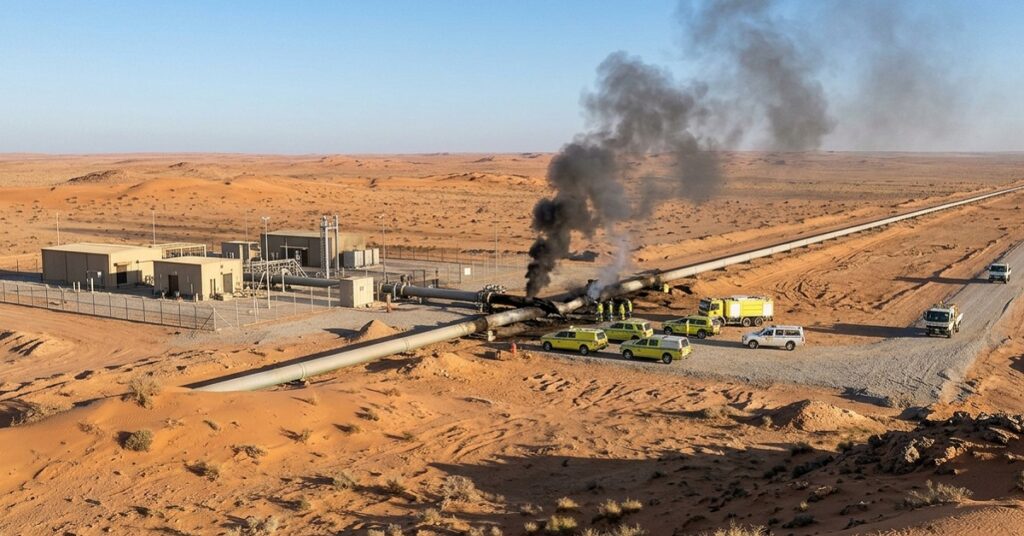
Severe Saudi East-West pipeline damage caused by recent drone strikes has forced state energy giant Aramco to suspend crude flows across the Arabian Peninsula. The attack targeted critical pumping stations along the 1,200-kilometer Petroline route, effectively cutting off the Kingdom’s primary bypass around the obstructed Strait of Hormuz. Consequently, global benchmark crude prices breached $100 per barrel as supply concerns intensified across international commodity markets. Energy traders and geopolitical analysts are closely watching the facility to assess repair timelines and determine whether prolonged shutdowns will further disrupt international crude deliveries.
Estimated reading time: 6 minutes
Key Takeaways
- Recent Saudi East-West pipeline damage from drone strikes has halted crude flows, causing global oil prices to spike over $100 per barrel.
- The attack on September 10 targeted key pumping stations, leading to a full operational shutdown and concerns over international supply disruptions.
- Aramco faces significant challenges in rerouting exports due to restricted pipeline capacity and elevated shipping risks around the southern tip of Africa.
- The incident highlights vulnerabilities in Middle Eastern energy routes and could lead to increased investments in alternative infrastructure and supply diversification.
- As repairs unfold, energy traders must monitor ongoing developments to assess impacts on global market stability and supply chains.
Table of contents
- Unpacking the Saudi East-West Pipeline Damage and Attack Timeline
- Drone Attack Triggers Pipeline Shutdown as Regional Risks Mount
- East-West Pipeline Shutdown Triggers Global Oil Price Surge
- Aramco Yanbu Red Sea Crude Export Rerouting Challenges
- Long-Term Energy Market Implications and Industry Outlook
- Conclusion: Navigating the Impact of the Saudi Pipeline Outage
- Frequently Asked Questions (FAQs) About the Saudi Pipeline Damage
- Related Links
Unpacking the Saudi East-West Pipeline Damage and Attack Timeline
On September 10, multiple unmanned aerial vehicles launched from Iraqi territory targeted critical infrastructure along Saudi Arabia’s East-West Pipeline. The coordinated drone strikes inflicted structural damage on essential pumping stations in the Riyadh and Medina regions. Consequently, emergency response teams activated localized flaring procedures to relieve internal pressure and stabilize the main pipeline network.
The Saudi Ministry of Energy swiftly ordered a full operational shutdown as a precautionary measure. Satellite imagery from NASA’s FIRMS and European Copernicus systems quickly identified prominent smoke plumes and thermal anomalies along the facility route.
The table below outlines the key technical details and operational facts regarding the incident:
| Operational Metric | Pre-Attack Status | Current Status Post-Attack |
| Daily Pipeline Throughput | ~4.5 Million Barrels/Day | 0 Barrels/Day (Fully Suspended) |
| Primary Export Terminal | Yanbu Port (Red Sea) | Operating at Restricted Capacity |
| Main Supply Route | Eastern Province to Red Sea | Offline for Engineering Assessment |
| Global Price Impact | Stable ($80 – $85/barrel) | Spiked Past $100/barrel |
| Primary Risk Factor | Regional Chokepoint Distrust | Extended Outage & Transit Bottlenecks |
Drone Attack Triggers Pipeline Shutdown as Regional Risks Mount
The Saudi oil pipeline drone attack underscores growing vulnerabilities across Middle Eastern energy routes. Investigators confirmed that the long-range drones originated from southern Iraqi provinces, escalating regional diplomatic friction. In response, Iraqi authorities launched a formal investigation and dismissed regional military leadership to contain political fallout.
However, the physical operational losses remain the primary concern for international markets. Pumping stations provide the kinetic pressure necessary to push crude across elevated desert terrain. Because several stations suffered direct impacts, technical crews cannot safely maintain crude pressure along the trunk line. Therefore, Aramco technicians must conduct comprehensive integrity checks before attempting to restart flows.
Strategic Role of the Petroline Infrastructure
Saudi Arabia constructed the 1,200-kilometer Petroline to transport heavy and light crude directly from eastern fields to Red Sea ports. This infrastructure allows state exporters to bypass shipping chokepoints in the Persian Gulf entirely.
- Persian Gulf Bypass: Bypasses narrow naval routes to reach western export terminals directly.
- Massive Capacity: Built to carry over 5 million barrels per day under peak operating pressure.
- Red Sea Access: Connects directly to deepwater loading facilities at Yanbu port.
East-West Pipeline Shutdown Triggers Global Oil Price Surge
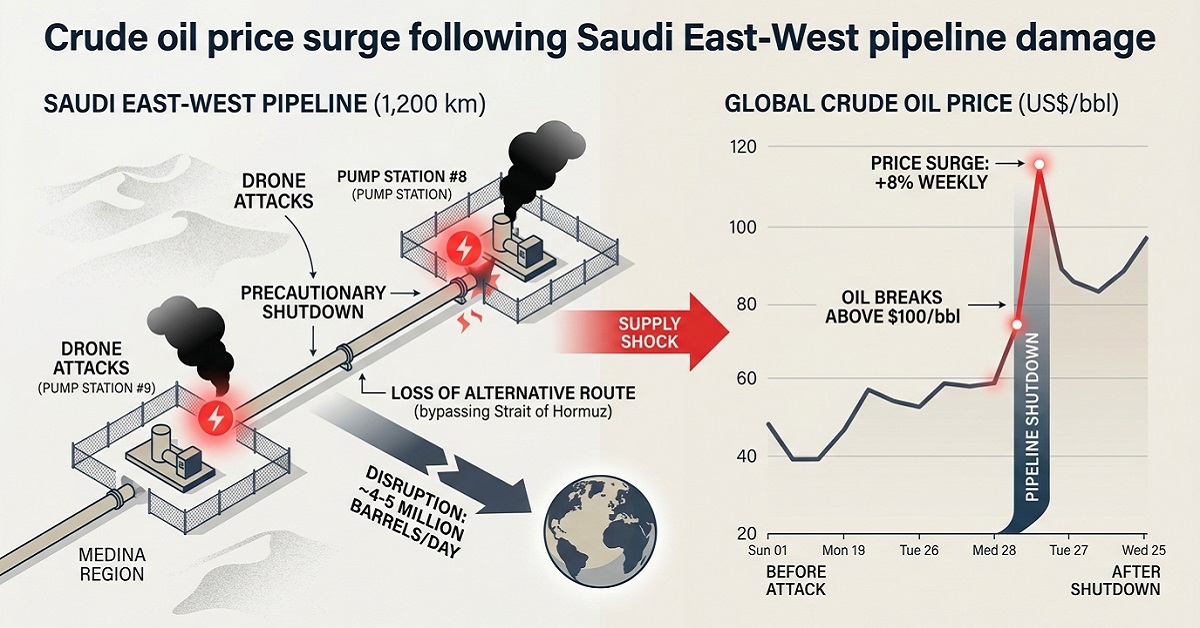
The sudden East-West pipeline shutdown global oil price reaction was immediate across major commodity exchanges. Traders quickly priced in a prolonged supply deficit because alternative export routes remain severely constrained. Furthermore, the shutdown removes approximately 4% of total daily global crude supply from active circulation.
Brent Crude futures rallied sharply, surpassing $100 per barrel within hours of the official announcement. West Texas Intermediate (WTI) followed a similar upward trajectory. Moreover, global shipping analysts warn that energy costs will remain elevated until repair timelines become clear.
In addition, international energy agencies warned that prolonged offline status could force major consuming nations to release strategic petroleum reserves.
Aramco Yanbu Red Sea Crude Export Rerouting Challenges
The strategy surrounding Aramco Yanbu Red Sea crude export rerouting faces immense operational friction. Saudi Arabia previously intended to utilize Yanbu as its safe-haven export hub while Persian Gulf transit faced elevated risk. However, without the pipeline supplying crude westward, export volumes at Yanbu have dropped drastically.
Consequently, Aramco must explore alternative logistics strategies to honor long-term supply contracts. Transporting crude via ocean tankers around the southern tip of Africa adds thousands of nautical miles to transit journeys. Therefore, shipping delays and elevated freight costs will persist for international importers.
Long-Term Energy Market Implications and Industry Outlook
The structural impact of this disruption extends far beyond immediate price volatility. Global energy markets remain hyper-sensitive to infrastructure vulnerabilities across key supply corridors. As a result, market analysts expect elevated price floors across energy commodities through the coming quarters.
In addition, supply security concerns will likely accelerate investments in alternative regional infrastructure and strategic buffer stocks. Sovereign importers in Asia and Europe are already evaluating supply diversification plans to mitigate future exposure.
Conclusion: Navigating the Impact of the Saudi Pipeline Outage
The recent Saudi East-West pipeline damage marks a major shift in global energy security and oil market dynamics. With critical pumping stations offline and crude shipments halted across the Petroline route, global supply chains face immediate bottlenecks. As Aramco works to assess repair timelines and navigate export rerouting challenges, energy traders and policy watchers must closely monitor updates on facility restoration and regional maritime security.
Read more on Google News . To stay informed on real-time developments, market analysis, and global trade impacts, bookmark our World news coverage and subscribe to our daily news updates.
Frequently Asked Questions (FAQs) About the Saudi Pipeline Damage
A series of targeted drone strikes launched from regional militia sites damaged several key pumping stations, prompting a precautionary total shutdown.
The pipeline previously carried up to 5 million barrels per day. Removing this volume from active circulation pushed global oil benchmarks over $100 per barrel due to acute supply deficits.
Rerouting options are severely limited. Marine shipping routes face elevated war risks, making immediate compensation for lost pipeline volume difficult.
Related Links

TOP
STORIES